

Forehead and brow lift
A forehead and brow lift is a surgical procedure designed to rejuvenate the upper face by elevating drooping eyebrows and smoothing deep-set wrinkles across the forehead.
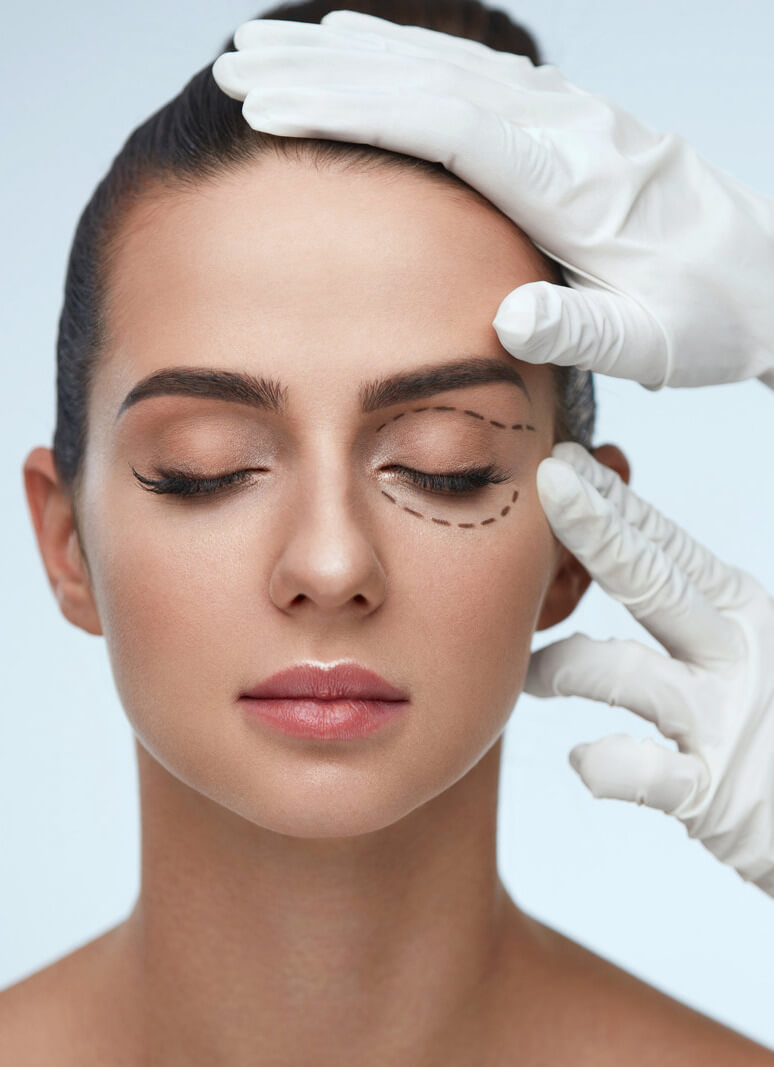
Forehead and brow lift
A forehead and brow lift is a surgical procedure designed to rejuvenate the upper face by elevating drooping eyebrows and smoothing deep-set wrinkles across the forehead. This procedure corrects the "heavy" appearance that occurs as the brow descends with age, opening up the eye area and restoring a more alert, youthful expression. Our goal is to achieve a subtle, natural elevation that eliminates a tired or concerned look without compromising your natural facial mimicry.
The upper third of the face is often the first area to show significant signs of aging. Over time, the supportive tissues of the forehead weaken, causing the eyebrows to shift downward. This descent not only creates horizontal forehead furrows and vertical "frown lines" between the eyes but can also contribute to excess skin hanging over the upper eyelids. A brow lift addresses these structural changes by repositioning the brow to its natural, more youthful horizontal plane.
What is a Forehead and Brow Lift?
A brow lift involves the strategic repositioning of the muscles and tissues of the forehead. By lifting the skin and underlying structures, the surgeon can smooth the forehead and raise the eyebrows to a position that better frames the eyes. This procedure is frequently performed alongside a facelift or eyelid surgery (blepharoplasty) to provide a harmonious rejuvenation of the entire face.
Several techniques are utilized depending on the patient's hairline and the degree of correction required:
- Endoscopic Brow Lift: The modern gold standard, using several small incisions hidden within the hair. A tiny camera (endoscope) guides the surgeon in releasing and lifting the tissue with minimal disruption.
- Temporal (Lateral) Brow Lift: Focuses on the outer portion of the eyebrows to address "hooding" at the corners of the eyes, utilizing small incisions in the temple hairline.
- Trichophytic (Pretrichial) Lift: An incision is made at the very edge of the hairline, ideal for patients with a high forehead who wish to lower or maintain their hairline while lifting the brow.
- Coronal Brow Lift: A traditional technique involving a single incision from ear to ear behind the hairline, reserved for cases requiring significant correction.
Who is a forehead and brow lift for?
This procedure is highly effective for individuals who feel their upper face appears prematurely aged or stern. You may be a candidate if:
- Your eyebrows have sagged into a low or flat position, creating a tired appearance.
- You have deep horizontal creases across your forehead.
- You have prominent vertical furrows between your eyebrows (glabellar lines).
- Excess brow tissue is contributing to "hooding" of the upper eyelids.
- You find yourself constantly raising your eyebrows to clear your field of vision or look more awake.
Before the operation
Your consultation will involve a detailed analysis of your upper facial anatomy, including your hairline height, forehead muscle activity, and the current position of your brow in relation to the orbital rim. Your surgeon will demonstrate the expected results by gently manually lifting the forehead skin during the exam.
Preoperative preparations include a review of your medical history and a clinical skin assessment. You will be instructed to avoid smoking and certain anti-inflammatory medications for several weeks prior to surgery. Because the scalp is involved, you may be asked to avoid certain hair treatments or dyes shortly before the procedure.
During the operation
The procedure is performed under general anesthesia or intravenous sedation and typically lasts between 1 and 2 hours. In an endoscopic lift, the surgeon makes three to five small incisions within the hair. Using specialized instruments, the forehead tissue is freed from the bone and lifted. It is then secured in its new position using small, dissolvable fixation devices or sutures.
The muscles that cause frowning may also be modified to soften vertical lines permanently. Once the brow is securely positioned, the small incisions are closed with fine sutures or clips. A protective dressing or a light bandage is applied around the forehead to provide support during the initial phase of healing.
After the operation and recovery
In the days following surgery, it is common to experience some swelling and bruising, which may descend into the cheek and eye area. Keeping your head elevated, even while sleeping, is essential for the first week to minimize this. Most patients experience a sensation of tightness or temporary numbness in the forehead and scalp, which resolves gradually as the nerves recover.
Most patients return to work and social activities within 10 to 14 days. Strenuous exercise, heavy lifting, and activities that increase blood pressure in the head should be avoided for at least 3 to 4 weeks. The final results emerge as the swelling subsides, typically within 2 to 3 months, revealing a refreshed and naturally elevated brow line.
Will a brow lift give me a "surprised" look?
A common concern is looking perpetually surprised. Modern techniques focus on "repositioning" rather than "over-pulling." By addressing the underlying muscles and securing the tissue at a natural height, an experienced surgeon ensures that the brow looks relaxed and refreshed, not unnaturally high.
Where will the scars be?
For most patients, the incisions are placed entirely within the hair-bearing scalp, making them virtually invisible once the hair grows back. If a hairline incision (trichophytic) is used, it is placed at the very edge of the forehead where the hair begins, allowing hair to grow through the scar and camouflage it effectively.
How is this different from a "cat eye" lift?
While a brow lift focuses on the functional and aesthetic elevation of the entire forehead and brow, a "cat eye" lift (canthopexy or canthoplasty) specifically targets the outer corner of the eye to create an upward tilt. A brow lift provides a broader rejuvenation of the upper face rather than just changing the eye shape.
Can Botox achieve the same result?
Botox can provide a "chemical brow lift" by relaxing the muscles that pull the brow down, but the effect is subtle and temporary (lasting 3 to 4 months). For patients with significant skin laxity or deep structural sagging, surgery is the only way to achieve a significant and long-lasting correction.
Every question gets an answer
Get a free consultation by booking a consultation with our consultants.