
Brachioplasty
Brachioplasty, or an arm lift, is a surgical procedure designed to reshape the upper arm by removing excess "hanging" skin and localized fat deposits.
Brachioplasty
Brachioplasty, or an arm lift, is a surgical procedure designed to reshape the upper arm by removing excess "hanging" skin and localized fat deposits. This procedure is especially effective for individuals who have experienced significant weight loss or the natural loss of skin elasticity due to aging. Our goal is to create a more toned, slender, and proportional arm contour that restores confidence when wearing sleeveless clothing and improves overall physical comfort.
The skin of the upper arm is relatively thin and prone to stretching. Over time, or following massive weight loss, the underlying tissues can lose their structural support, leading to a condition often referred to as "bat wings." Because skin cannot be tightened through exercise alone, a brachioplasty is necessary to surgically excise the redundant tissue and tighten the underlying supportive fascia.
What is Brachioplasty?
An arm lift focuses on the area between the underarm and the elbow. The procedure is tailored to the degree of skin laxity present:
- Traditional Brachioplasty: This is the most common approach for significant skin excess. It involves an incision that runs along the inside or back of the arm. It allows for the greatest amount of skin removal and provides the most dramatic reshaping.
- Minimal Incision (Hidden) Arm Lift: If the excess skin is located close to the armpit, the incision may be placed entirely within the axilla (underarm). This is suitable for patients with moderate laxity.
- Extended Brachioplasty: In cases of massive weight loss, the incision may extend from the arm down the side of the chest wall to address skin laxity that continues onto the torso.
Liposuction is frequently used during the procedure to thin the fatty layer before the skin is tightened, ensuring a smooth and tapered transition to the elbow and forearm.
Who is brachioplasty for?
This procedure is designed for men and women who are bothered by loose, sagging skin on their upper arms. You may be a candidate for an arm lift if:
- You have significant "hanging" skin that makes you self-conscious in short-sleeved or sleeveless clothing.
- Your arm skin does not contract despite achieving a stable, healthy weight.
- You experience skin irritation or rashes in the folds of the upper arm.
- You are at a stable weight and in good overall health.
- You understand that the trade-off for a slimmer arm is a permanent scar on the inner arm.
Before the operation
Your consultation will involve an assessment of your skin elasticity and the amount of fat present in the upper arms. Your surgeon will discuss the placement of the incision; while we always aim for the most discreet placement, the length of the scar is directly proportional to the amount of skin being removed.
Preoperative instructions include a strict requirement to stop smoking for at least six weeks before and after surgery. Nicotine is particularly detrimental to arm lift healing because the skin in this area is under constant tension from arm movement. You must also avoid blood-thinning medications to minimize the risk of postoperative hematoma.
During the operation
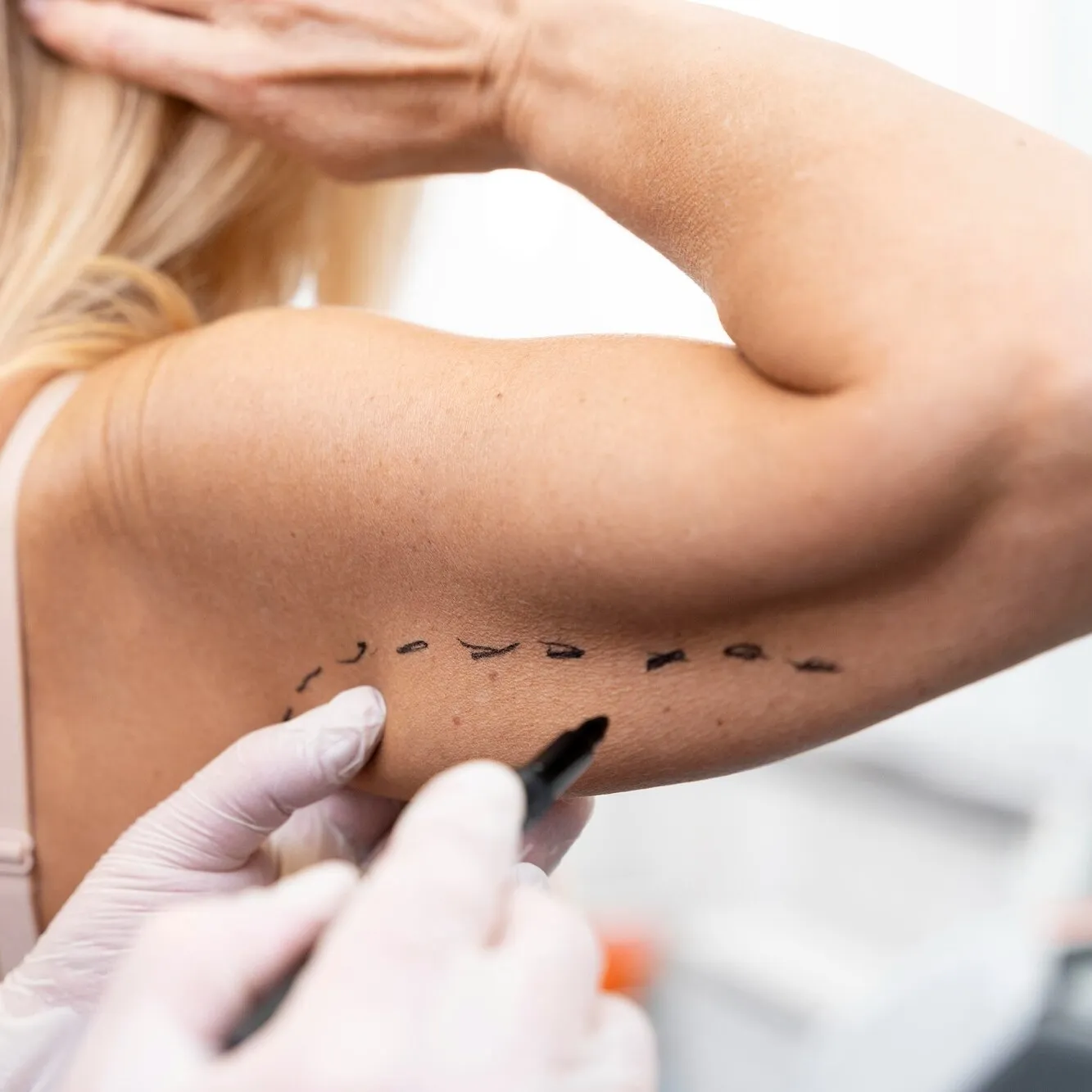
Brachioplasty is performed under general anesthesia and typically takes 2 to 3 hours. The surgeon marks the excess skin while you are in a standing or seated position to ensure accuracy.
Once the incision is made, the surgeon removes the redundant skin and fat. The underlying supportive tissue (fascia) is tightened with internal sutures to define the new shape. The skin is then redraped over the new contour, and the incisions are closed with multiple layers of sutures to minimize scar widening. Temporary drains may be placed to prevent fluid buildup, and the arms are wrapped in compression bandages.
After the operation and recovery
Immediately after surgery, you will need to keep your arms elevated on pillows to reduce swelling. You will be fitted with a specialized compression sleeve that must be worn for several weeks. Most patients experience a sensation of "heaviness" or tightness in the arms, but sharp pain is usually minimal and managed with prescribed medication.
Most patients return to light activities and sedentary work within 10 to 14 days. However, you must strictly avoid heavy lifting, reaching overhead, or vigorous arm movements for at least 6 weeks. The final, refined contour will be fully realized after 3 to 6 months as the swelling subsides and the tissues settle.
Where will the scar be located?
In a traditional brachioplasty, the scar runs from the armpit to just above the elbow. It is placed either on the inner side of the arm (facing the body) or on the back of the arm, depending on which placement provides the most effective lift for your anatomy. While the scar is permanent, it typically fades from red to a thin, pale line over 12 to 18 months.
Can I just use liposuction instead?
Liposuction is only effective if you have good skin elasticity. If your primary concern is "hanging" skin, liposuction alone will actually make the problem worse by removing the fat that was previously filling the skin, resulting in even more sagging. If you have significant skin laxity, an arm lift is the only way to achieve a firm result.
Will my arm strength be affected?
No. Brachioplasty only involves the skin, fat, and the superficial fascia. It does not involve the muscles or tendons responsible for arm movement or strength. Once you have fully recovered and the tissues have healed, your arm function and strength will be exactly as they were before surgery.
How long do the results last?
The results of an arm lift are long-lasting, provided you maintain a stable weight. While the natural aging process will continue and the skin may lose some firmness over the decades, the significant "hanging" tissue removed during surgery will not return.
Every question gets an answer
Get a free consultation by booking a consultation with our consultants.